Noticing a prominent or fuller than desired male chest is something that many men experience at some point in their lives, but it is not always easy to tell whether it is gynaecomastia or simply fat accumulation in the pectoral area. The difference between gynecomastia or pectoral fat is not just a technical detail: it completely determines the type of treatment that makes sense to consider and whether or not surgery is the best option.
In clinical practice, confusion between the two situations is very common. There are people who have been exercising and dieting for years without managing to reduce the volume of their breasts because the cause is not fat but glandular tissue. And there are others who have gone to a consultation worried about a possible gynaecomastia when in reality the problem is due to weight or body composition factors. Knowing how to distinguish between the two is the first step in making informed decisions.
What exactly is gynaecomastia and how does it differ from breast fat?
Gynecomastia is the enlargement of glandular breast tissue in the male breast. It is not fat: it is tissue, similar in structure to female breast tissue, which develops in the retroareolar area, i.e. just behind the nipple. It can affect one or both sides of the breast and, in some cases, causes tenderness or slight discomfort to the touch.
Pseudogynecomastia, on the other hand, is the accumulation of fat in the pectoral area without any increase in glandular tissue. The external appearance may be similar, a breast with more volume than usual, but the origin is different and so is the approach.
The clinical distinction between the two is important because fat responds, at least partially, to changes in weight and exercise. The glandular tissue of true gynecomastia does not disappear with diet or breast training, no matter how much effort is put into it. When someone has been working the chest in the gym for months or years without seeing any improvement in volume or shape, that is a relevant sign that deserves medical evaluation.
How to tell if you have gynecomastia or chest fat
Although a definitive diagnosis always requires a clinical examination by a specialist, there are some signs that can help to indicate whether you have gynaecomastia or fat accumulation.
| Aspect to be assessed | True gynaecomastia | Pectoral fat or pseudogynecomastia |
|---|---|---|
| Origin | Enlargement of breast glandular tissue. | Fat accumulation in the pectoral area. |
| Consistency | It tends to feel firmer, especially behind the nipple. | Softer, diffuse and uniform. |
| Location | More focused on the areola and nipple. | More spread across the chest. |
| Response to the exercise | It does not disappear with chest training. | May improve with fat loss and body composition changes. |
| Sensitivity | There may be tenderness or discomfort to touch. | It does not usually cause localised pain. |
| Standard treatment | Removal of glandular tissue, sometimes combined with liposuction. | Fat loss, healthy habits or liposuction in selected cases. |
In true gynecomastia, it is common to notice an area of increased firmness just below the nipple, like a small nodule or disc of firm tissue that is clearly differentiated from the surrounding fat. This tissue may be tender to the touch or even mildly painful in some cases, especially in phases of active hormonal development. The nipple may have a larger projection than usual and the areola may be slightly enlarged.
In pseudogynecomastia the tissue is softer and more uniform, without that area of greater central consistency. The distribution of volume is usually more diffuse and symmetrical with the rest of the body fat. In overweight people, the accumulation in the chest is often accompanied by fat in other areas such as the abdomen or flanks.
That said, there are cases where both components coexist: glandular tissue and pectoral fat at the same time. In these situations the diagnosis is more complex and surgical treatment, if considered, must address both components to achieve a balanced result.
Causes of gynaecomastia: why breast tissue appears on the male breast
Gynecomastia has a hormonal origin in most cases. It occurs when there is an imbalance between oestrogen and testosterone levels, which favours the development of glandular tissue in the breast. This imbalance can occur at different stages of life and for different reasons.
In adolescence, gynaecomastia may appear temporarily due to the hormonal changes associated with puberty. It usually improves spontaneously in one or two years, although in some patients it persists beyond this stage and a medical assessment is advisable.
During adulthood, the most common causes may include hormonal disturbances, certain medications, anabolic steroid use, significant weight changes or some endocrinological diseases. When no specific medical cause is identified, it is referred to as idiopathic gynecomastia.
After a certain age, it may also be related to a progressive decline in testosterone levels. In these cases, if breast enlargement causes physical discomfort or aesthetic concern, surgery may be an effective option to correct it.
Diagnosis: clinical examination and imaging tests
The diagnostic process begins with a physical examination in the consultation room. The surgeon assesses the type of tissue present, the degree of augmentation, the symmetry between both sides of the breast and the projection of the nipple and areola. Depending on the findings, a breast ultrasound may be requested, which allows a clear differentiation between glandular tissue and fat, and rules out other pathologies.
In some cases, especially when a hormonal or metabolic cause is suspected, the study is completed with a blood test that includes a hormone profile. The aim is not only to confirm the presence of gynecomastia but also to identify if there is any underlying factor that should be treated before or in parallel to surgery.
It is this diagnostic process that makes it possible to design a truly personalised treatment plan, adapted to the anatomical characteristics of each patient and their real expectations.
When to operate: criteria for considering gynaecomastia surgery
Gynecomastia surgery is considered when the increase in breast tissue is persistent, does not respond to changes in weight or exercise and causes physical discomfort or concern about the appearance of the breast. There is no single indication: the decision is made on an individual basis after assessing the patient's clinical situation, evolution and expectations.
There are some situations in which the indication for surgery is clearer. When gynaecomastia has been unchanged for more than two years and spontaneous resolution can no longer be expected, surgery is usually the most effective option. Also when the volume is significant, when there is marked asymmetry between the two sides of the breast, or when the situation is clearly affecting the person's well-being or quality of life.
In contrast, if the gynecomastia is recent or related to an identifiable and treatable factor, such as the use of a substitutable medication or a correctable hormonal imbalance, it may make sense to wait and treat the cause first before considering surgery.
In the case of pure pseudogynecomastia, the indication for liposuction surgery is considered when the accumulation of fat in the breast is disproportionate, localised and does not respond adequately to changes in body composition. It is not the first line of treatment, but in certain cases it is a valid and effective option.
What surgery involves: techniques and what to expect
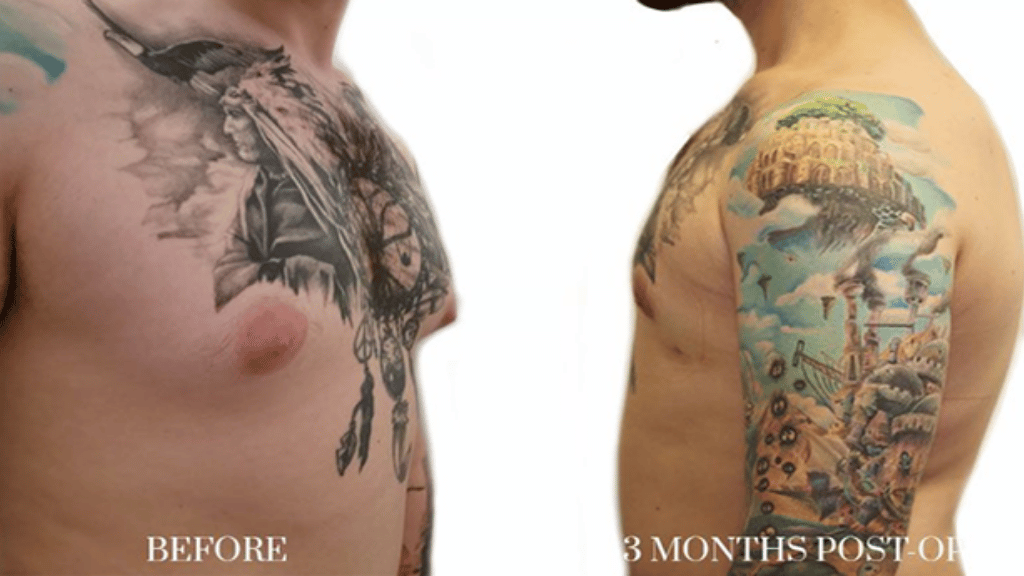
The type of intervention depends on the predominant component. When glandular tissue is present, the usual technique consists of removing it through a small incision at the lower edge of the areola, which is concealed in the natural transition between the areola and the skin of the breast. When the fat component is significant, it is combined with liposuction of the pectoral area to achieve a more uniform and proportionate contour. In situations where there is excess skin, a periareolar adjustment can also be performed.
It is a relatively short procedure, lasting between 45 and 80 minutes, which usually allows the patient to return home the same day. Full recovery takes about a month, although most patients can return to their normal activities within a few days. The results are visible from the first few weeks and are consolidated over the following months, as the swelling disappears and the breast contour settles.
The Dr. Richard Fakin, Swiss-Italian plastic surgeon with experience in aesthetic, reconstructive and gender-reaffirming surgery in Madrid and Zurich, performs an individualised assessment of each case to determine which technique or combination of techniques offers the most balanced and natural result for each anatomy. Her international training and her focus on precise and proportional results are aspects that patients consistently highlight in their patient testimonials.
Frequently asked questions about gynaecomastia and pectoral fat
Can I tell for myself if I have gynecomastia or is it chest fat?
Can gynaecomastia be solved without surgery?
How long is the recovery time after gynaecomastia surgery?
Are the results of the surgery permanent?
Does gynecomastia surgery leave visible scars?
When to consult a gynaecomastia specialist
Gynecomastia, whether true or in combination with pectoral fat, is a situation that is more common than is usually recognised and has a solution when the diagnosis is correct and the treatment is well indicated. Understanding the difference between glandular tissue and fat accumulation is key to not looking for solutions in the wrong place or spending years in the gym waiting for results that cannot be achieved in this way.
If you have had doubts about your breast contour for some time, the best decision is to consult a specialist who can make a real assessment of your case. The Dr. Richard Fakin and its team in Madrid and Zurich work with an individualised approach, combining precise diagnosis and highly specialised surgical techniques to achieve proportional and natural results.
You can find more information about the procedure on the page of gynecomastia surgery or contact us directly to solve your doubts in a first consultation.
This article is for information purposes only and is not a substitute for a personal medical assessment. Always consult a qualified specialist before making any treatment decision.