A forehead lift is a surgical procedure that alters the shape or height of the forehead. Many people with a large forehead feel that their face lacks harmony, and for trans women, the forehead is also one of the areas that most influences how the face is perceived. This article explains the techniques involved in a forehead lift, the differences between forehead reduction and forehead contouring, who may be a suitable candidate, and the role this surgery plays in the facial feminization.
What is a forehead lift?
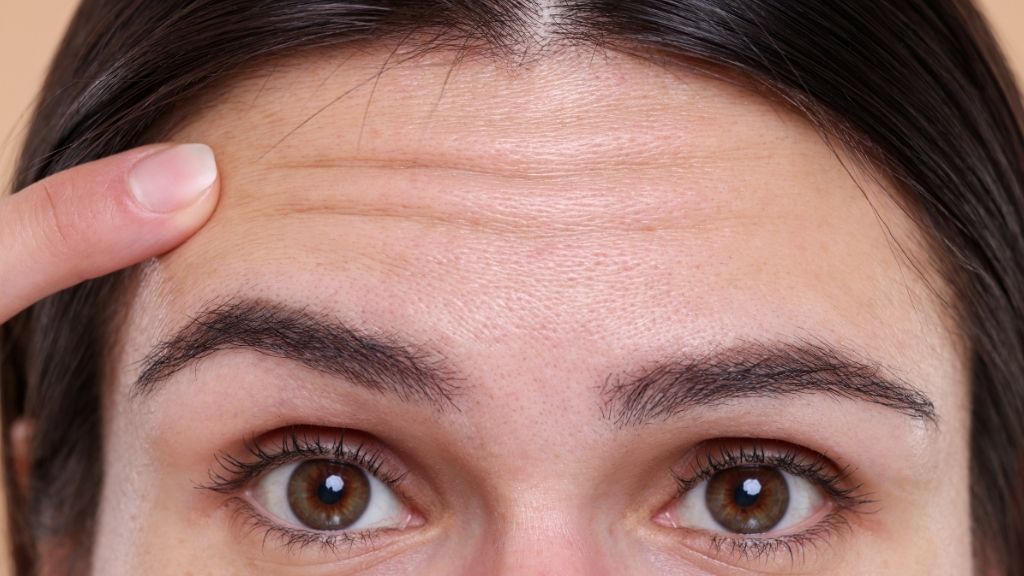
A forehead lift is a surgical procedure that reshapes the forehead. It involves two techniques: forehead reduction, which lowers the hairline to reduce the height of the forehead, and forehead contouring, which smooths the bone above the eyebrows. These can be performed separately or as part of the same procedure, depending on the individual’s anatomy.
Forehead reduction and forehead contouring: two different techniques
A forehead lift is not a single technique. A forehead reduction involves the skin and hairline, whilst forehead contouring involves the bone.
A forehead reduction reduces the distance between the eyebrows and the hairline. The surgeon makes an incision along the hairline, removes a strip of skin from the forehead and moves the scalp forwards. A trichophytic incision is usually used; this is a cut designed to allow hair to grow through the scar, making it less visible.
Frontal contouring alters the supraorbital arch, which is the bony prominence situated above the eyebrows. In men, this prominence is usually more pronounced. Where the bone is sufficiently thick, the surgeon files it down to smooth it out. Where there is a large frontal sinus underneath – a cavity containing air within the frontal bone – the surgeon removes the anterior wall of the bone, reshapes it and repositions it further back.
| Technique | What it changes | When is it indicated? | What it does not correct |
|---|---|---|---|
| Forehead reduction | The height of the forehead and the position of the hairline | A wide forehead with a high hairline | The protrusion of the bone above the eyebrows |
| Front contouring | The shape of the frontal bone and the superciliary arch | Prominent brow ridge or a forehead with a bulging profile | The height of the forehead |
| Combined techniques | The height of the forehead and the shape of the bone | A high forehead with a pronounced brow ridge, commonly seen in facial feminisation | Very steep lateral entrances, which may require other techniques |
The role of forehead lift surgery in facial feminisation
When it comes to facial feminisation, a forehead lift is one of the procedures that most dramatically alters the appearance of the face. The forehead occupies a large part of the face, and its shape is one of the most obvious differences between male and female features.
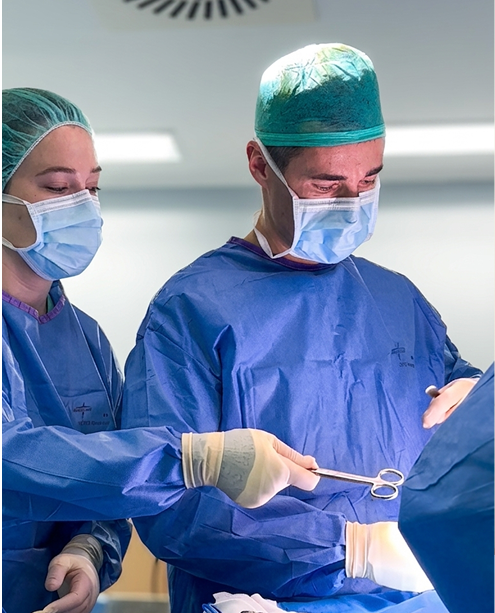
A forehead with a feminine profile is usually shorter, smoother and does not protrude above the eyebrows. For this reason, it is common for trans women to combine forehead contouring with a forehead reduction. Both techniques use the same incision along the hairline, which means they can be carried out in a single operation.
A forehead lift forms part of a wider plan. Facial feminisation aims to create a harmonious face that is consistent with each person’s identity, which is why the forehead is assessed alongside the rest of the facial features.
The three main facial feminisation surgeries
In this reel, Dr Richard Fakin explains the three main procedures involved in facial feminisation: forehead reduction, feminising septorhinoplasty and chin feminisation. Feminising septorhinoplasty alters the shape of the nose and, where necessary, corrects the nasal septum. Chin feminisation reduces and softens the shape of the chin.
Who is a suitable candidate for a forehead lift?
Any adult in good health who has a large forehead, a pronounced brow ridge, or both, and who wishes to alter these features may be a candidate for a forehead lift.
Trans women seeking to feminise their faces are one of the most common groups. Cisgender women – that is, women whose gender identity matches the sex assigned at birth – who have a naturally high forehead also seek treatment.
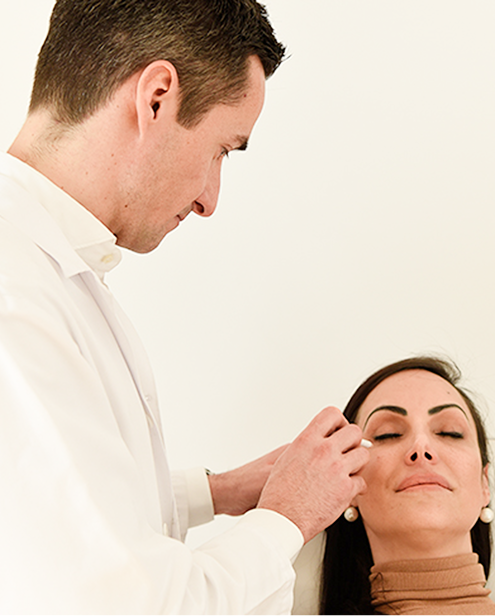
During the consultation, the height of the forehead, the shape of the frontal bone, hair density and the elasticity of the scalp are assessed. Elasticity is important because it determines how far the hairline can recede. Imaging tests, such as a CT scan – a radiological examination that shows the bone in three dimensions – are used to examine the frontal bone and sinus.
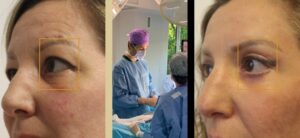
Before and after facial contouring: a case by Dr Richard Fakin
This image shows a patient’s profile before and after frontal contouring, photographed in the operating theatre. The box highlights the supraorbital arch, the area that is altered during the procedure.
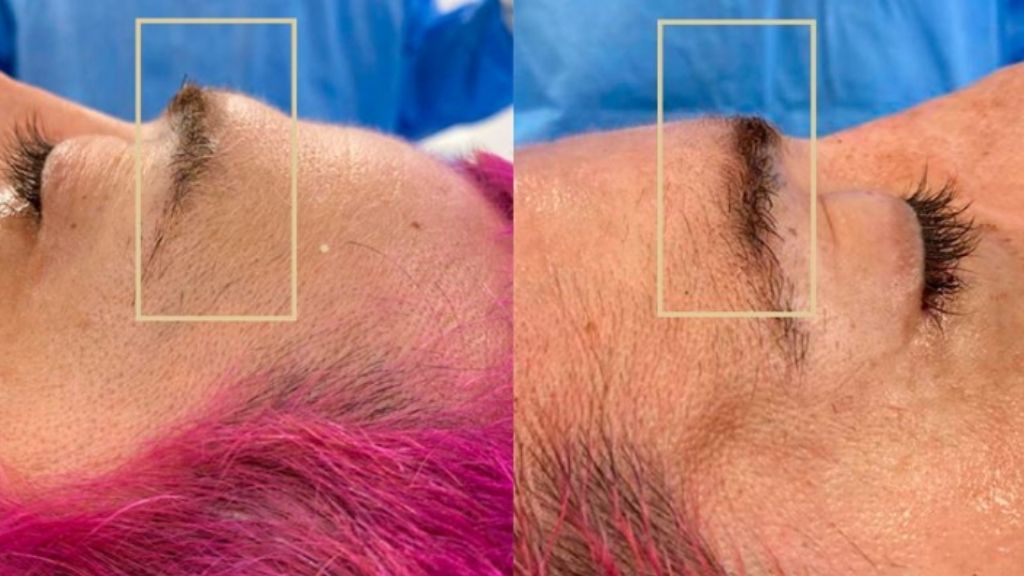
Before the procedure, the bone above the eyebrow forms a visible prominence when viewed in profile. Afterwards, the line from the forehead to the eyebrow flows more smoothly. The final result can be assessed once the swelling has subsided.
Recovery and safety following a forehead lift
Recovery from a forehead lift focuses on managing swelling and protecting the scar along the hairline. Specific instructions are provided by the medical team on a case-by-case basis.
After the operation, it is common to experience swelling on the forehead and around the eyes, sometimes accompanied by bruising. A reduction in sensation on the scalp behind the incision is also common, but this usually recovers gradually. Attending follow-up appointments allows the surgeon to check that the healing process is progressing correctly.
The risks are explained during the consultation before a decision is made. Among the most common are bruising, infection, scarring problems, temporary hair loss around the incision, changes in sensation and minor asymmetries.
Forehead reduction with Dr Richard Fakin in Madrid and Zurich
A forehead lift allows the height of the forehead, the shape of the frontal bone, or both to be altered. In facial feminisation, forehead reduction is usually combined with forehead contouring, as part of a plan that assesses the face as a whole.
At the clinics in Madrid and Zurich, the PD Dr. Richard Fakin, a Swiss-Italian plastic surgeon specialising in plastic, reconstructive and cosmetic surgery, as well as gender-affirming surgery, assesses each case on an individual basis. The title PD (Privatdozent) is an academic accreditation awarded by Swiss universities that recognises the holder’s ability to teach at university level. Further information on the full process can be found on the facial feminisation surgery in Madrid, in the article on body feminisation procedures and in the patient testimonials.
Would you like to find out whether a forehead lift is the right option for you?
Book a consultation with Dr Richard Fakin in Madrid or Zurich. He will assess the shape of your forehead and explain which technique is best suited to your case.
Book an appointment for an assessment